
Are there too many or too few communicators in government? That's what the Swedish government has set out to investigate. The debate about public communication is strange and superficial, according to a Swedish researcher.

22 August 2023
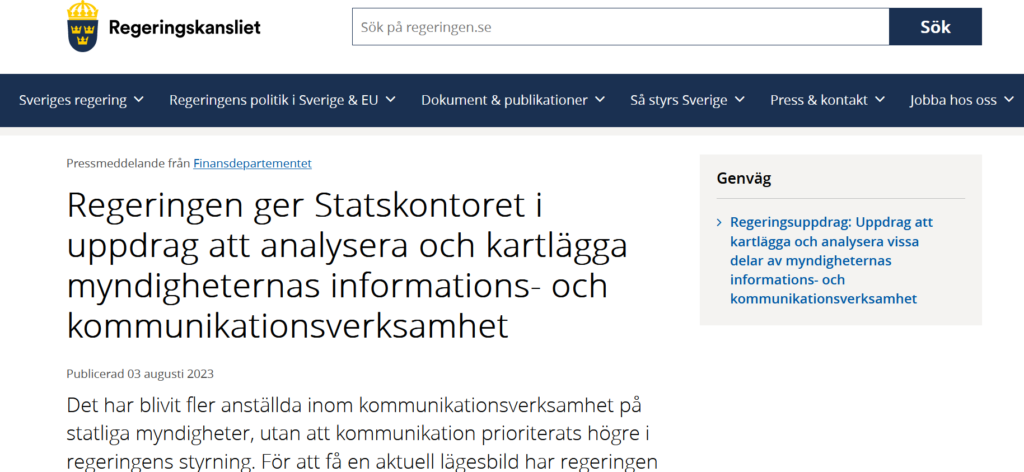
On 3 August 2023, the Swedish government launched an investigation to map and analyze 'certain parts of the Swedish authorities' information and communication activities', as it is stated in the Swedish Ministry of Finance's communication about it.
From the description (in Swedish) of the investigation, it is described that the Swedish government in its financial bill for 2023 has emphasized that the main tasks for the state must stand out clearer and that the core tasks of the public authorities must be prioritized.
'Informing and communicating is a natural and important part of the work of many public authorities - but the question is how much communication and which types of communication are appropriate based on the tasks that the authorities have,' according to the Swedish Ministry of Finance press release.
The number of public sector communicators is rising
The press secretary for Erik Slottner, the Swedish Civil Affairs Minister, refers to the findings of a Swedish expert group in public finance studies in the report The Swedish expert groups 2021 report 'No commercials please' from 2021, in which it was concluded, that Swedish authorities' communication activities have grown over time.
In 2019, approx. 3,600 people worked with information and communication at least 40 percent of their working time, an increase of 46 percent compared to 2006.
Do the tasks of the authorities match reality?
It seems perfectly reasonable to examine whether the amount of communication fits the tasks that the authorities have.
It would probably be just as reasonable to investigate whether the tasks of the authorities fit the reality of which we are a part.
In both Sweden, Europe and the rest of the Western world, we hear about the crisis of trust and legitimacy of participatory democracy and liberal democracy, about disinformation and misinformation, about influence operations from foreign powers, about big tech's algorithms and their impact on the public debate, about public service media and the rest of the traditional media's impact decline and the consequences this has for the idea of the informed citizen in the enlightened democracy.
Who will carry out those tasks? What role will public communication play in that context in the future? A little, a lot, nothing? The Swedish government's investigation will not provide answers to that. But it would be a good thing to find out what ordinary people think about it at some point.
An old dicussion
The problem is not new in Sweden according to public communication researcher Magnus Fredriksson from the University of Gothenburg. He refers, among other things, to the fact that the Swedish government's investigation description refers to similar debates at the beginning of the millennium, and that the topic has been written about from a research perspective on several occasions.
For example, the political scientist Hanna Kjellgren described in her thesis The state as informer or propagandist? from 2002 the development of Swedish public sector information from the end of the Second World War to around the year 2000.
A weird public debate
Magnus Fredriksson thinks the current public debate about public communication is a bit weird.
- If you take the criticism that, for example, the Taxpayers' Association and the Waste Ombudsman (Swedish interest organisations, ed.) have come up with, then it has focused a lot on the fact that public sector communication costs money. But if you look at what the state puts into failed IT projects, for instance, the costs for public communication are very much smaller.
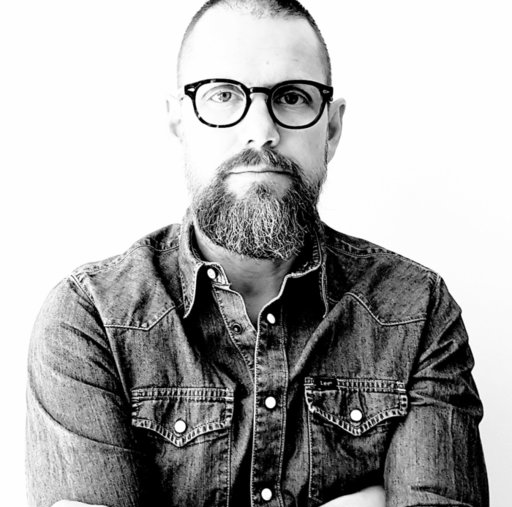
In Magnus Fredriksson's view, this may be connected to the fact that communicators are highly visible, not least from the perspective of journalists.
- When communicators act as gatekeepers in various cases, such debates arise. Where journalists have tried to get information out of the system and experienced that the communicators have functioned as gatekeepers.
Superficial
Moreover, the communication researcher believes that the debate tends to become superficial. From both sides.
- Those who criticize make quite unvarnished and unfounded claims. But those who defend also find it very difficult to come up with a good defence, I think. They talk about democracy and openness, they talk about transparency and dialogue, but what does that mean? What effect does it have?
- It should be possible for them to document more clearly which positive effects it can have if they initiate different types of efforts. In that respect, I think that they are sometimes a little bad at making good arguments. They often use very general arguments with fancy words like dialogue and democracy and so on, says Magnus Fredriksson.
Government investigation covers only part of the communication work
Ten years ago, in 2013, Magnus Fredriksson was involved in the preparation of the analysis 'With visibility as a guiding star', which is a mapping of the principles that govern Swedish authorities' communication. Communication and press strategies and other management documents from 173 out of 252 state authorities were included. From them it appeared, among other things, that
- 'Reputation management' was an important guiding principle for 85 percent of the authorities
- 'Production', i.e. support of the authorities' core tasks was a guiding principle for 82 percent of the authorities and that
- 'Civil principles', i.e. support for democratic processes, incl. facilitating access to the administration for journalists, was a guiding principle for 65 percent of the authorities
The authorities thus communicated with many purposes and on many matters in 2013. Magnus Fredriksson believes that has not changed.
- I have been following the area, and not an awful lot has changed. So I am a little surprised that they have chosen to examine only the part of the authorities' communication which aims to influence. Because what we have shown is that the authorities do a lot more than that. It is also interesting why it is exactly that type of communication that the government wants to highlight, and not all the other things that the authorities communicate about, says the researcher as the interview ends.
The Swedish government's investigation into the work of communicators working for the state will be published by 4 March 2024 at the latest.
Read more (in Swedish):
The state as informer or propagandist? – Hanna Kjellgren, political scientist, article from the University of Gothenburg, 2002
'With visibility as a guiding star' (2013): Magnus Fredriksson and Josef Pallas: An analysis of which principles govern the communication work in national administrative authorities
the ESO report The Swedish expert groups 2021 report 'No commercials please'
Government instruction 3 August 2023 (a task for the administration, set by the government) from the Ministry of Finance: Assignment to map and analyze certain parts of the authorities' information and communication activities
Press release from the Swedish Ministry of Finance, 3 August 2023: The government commissions the State Office to analyze and map the authorities' information and communication activities
 English
  Dansk
Dansk